
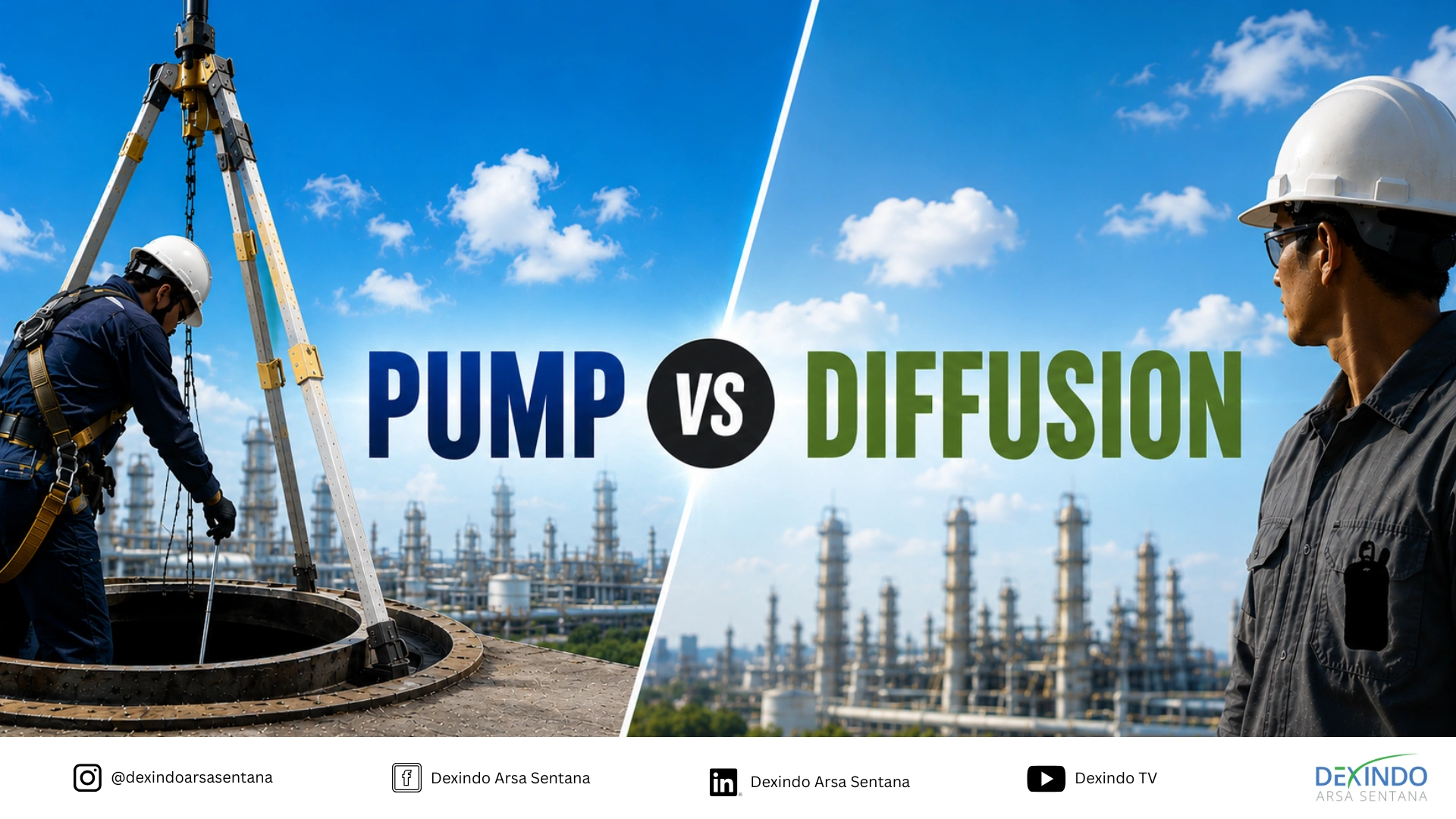
In the context of gas detectors, the terms diffusion and pump refer to gas sampling methods. A diffusion detector operates passively, allowing gas from the surrounding atmosphere to naturally enter the sensor, making the device generally lighter, more battery-efficient, and suitable for personal monitoring.
In contrast, a pump detector uses an internal pump to actively draw air into the sensor, enabling remote sampling through a hose and making it ideal for confined space applications and pre-entry testing. The sensors themselves can be the same, such as O₂, H₂S, CO, or LEL sensors; the key difference lies in how the gas reaches the sensor.
Read: Know the Different: Single vs Multi Sensor Gas Detectors
What Is a Diffusion Gas Detector?
A diffusion gas detector operates on the principle of passive molecular diffusion, the same physical phenomenon responsible for the spread of perfume through a still room. Gas molecules migrate from areas of high concentration to areas of lower concentration, and the sensor simply waits for those molecules to arrive.
The detector is placed in, or worn within, the environment being monitored. As ambient air moves naturally, driven by thermal convection, ventilation, or worker movement, gas molecules reach the electrochemical or catalytic sensor and trigger a reading. There are no moving mechanical parts dedicated to sampling; the only powered components are the sensor circuitry and the alarm system.
How Diffusion Works
Ambient gas migrates through a protective mesh or membrane and reaches the sensing element. An electrochemical sensor generates a micro-current proportional to the gas concentration, which the instrument’s electronics convert into a parts-per-million (ppm) or percentage LEL (Lower Explosive Limit) reading displayed in real time. When concentration crosses a pre-set threshold, audible, visual, and vibration alarms activate.
Where diffusion detectors excel
Diffusion instruments are the standard choice for personal gas monitoring, situations where continuous, real-time protection of an individual worker is the primary objective. Their lightweight, low-maintenance design makes them the workhorse of daily field operations: routine plant patrols, open-air inspection rounds, transportation of hazardous materials, and activities in well-ventilated process areas.
Because they draw no additional current to power a pump mechanism, diffusion detectors typically offer superior battery life often exceeding 18 to 24 hours on a single charge making them particularly valuable for extended shift work in remote locations.
⚠ Key Limitation
“Diffusion detectors only measure the atmosphere immediately surrounding the sensor. If the device is clipped to a worker’s chest harness, it reports conditions at breathing-zone height — not at floor level where heavier-than-air gases like H₂S and LPG vapours may accumulate, nor in remote or enclosed areas the worker has not yet entered.”
Read: Why Do Gas Detectors Trigger False Alarms? Causes and Solutions
What Is a Pump-Type Gas Detector?
A pump-type gas detector also called a pumped detector or active-sampling instrument incorporates a motorised diaphragm or aspirator pump that actively draws an air sample through attached tubing and into the sensor chamber. Rather than waiting for gas to diffuse to the sensor, the instrument goes to where the gas may be.
This active-sampling architecture gives the operator the ability to test a space from a safe, remote distance before anyone physically enters that space. Sampling hoses can extend, depending on manufacturer specifications, from a few metres up to approximately 50 metres, enabling atmospheric testing of tanks, manholes, vessel interiors, sub-floor voids, and other structures that are inaccessible or not yet declared safe.
How pump sampling works
The operator inserts a rigid probe or flexible hose to the sampling location. The internal pump activates, pulling a continuous flow of ambient air typically at flow rates around 0.5 litres per minute through the tubing and into the sensor array. The sensor responds rapidly because the sample arrives concentrated and direct, rather than relying on molecular drift. Readings stabilise within seconds, and the instrument reports atmospheric conditions at the point where the probe tip is positioned.
⚠ Critical Operational Note
“Gas behaviour varies by density. Methane and hydrogen are lighter than air and accumulate at high points; hydrogen sulphide, carbon monoxide at moderate levels, and LPG vapours are heavier and settle near the floor or in sumps. A pump detector allows stratified testing: sampling at the top, middle, and bottom of a confined space before entry — a practice mandated by OSHA and other regulatory frameworks.”
Where pump detectors are indispensable
Pump instruments are the regulatory and operational standard for confined space pre-entry atmospheric verification. Any time a worker cannot safely enter a space to take a measurement, a pumped detector makes that preliminary assessment possible from outside. This includes storage tanks, sewers and manholes, utility tunnels, reactor vessels, ship ballast tanks, excavations exceeding 1.2 metres in depth, and any space classified as a Permit-Required Confined Space (PRCS) under applicable standards.
Read: Gas Detector Bump Test vs Calibration Explained
Pump vs Diffusion Gas Detectors: Which One Is Better?
This is, frankly, the wrong question and experienced HSE professionals know it. Neither technology is universally superior. Each is optimal for a defined set of conditions. The better question is: which is right for your specific application?
That said, understanding the performance trade-offs across several dimensions allows both HSE teams and procurement officers to make defensible, audit-ready decisions.
| Criteria | Pump Detector | Diffusion Detector |
|---|---|---|
| Sampling method | Active — motorised pump draws sample Remote sampling capable | Passive — ambient gas migrates to sensor In-situ only |
| Confined space pre-entry | Regulatory standard; hose inserted before entry Mandatory use case | Insufficient alone; cannot test unoccupied space Not suitable |
| Personal / body-worn monitoring | Possible but bulkier and less comfortable Acceptable | Industry-standard; lightweight clip-on design Optimal choice |
| Response time | Faster — active draw delivers sample directly Typically <30 s | Flexible—Dependent on ambient airflow; can be slower in still air Variable |
| Sampling reach | Up to ~50 m via extended hose Remote capable | Sensor location only; no remote reach No remote capability |
| Stratified atmosphere testing | Yes — sample at multiple heights systematically Supported | Limited to sensor elevation only Not supported |
| Battery life | Reduced — pump motor draws significant power Lower endurance | Extended — no motor power draw; 18–24+ hrs common High endurance |
| Maintenance burden | Higher — pump diaphragms, filters, tubing require regular inspection and replacement More intensive | Lower — sensor calibration only Minimal |
| Failure modes | Pump failure, hose clogging, moisture ingestion, filter blockage More complex | Sensor drift, membrane fouling — simpler to diagnose Fewer components |
| Capital cost | Higher — pump mechanism adds cost Premium pricing | Lower — simpler construction Cost-effective |
| Total cost of ownership | Significantly higher when filters, tubing and pump maintenance included Higher TCO | Lower — fewer consumables, less maintenance downtime Lower TCO |
| Best-fit environment | Confined spaces, tanks, sewers, voids, manholes, pre-entry checks | Open process areas, personal protection, general patrols, transportation |
| Recommendation Gas Detector Unit | Portable Honeywell BW Max XT II | Portable Honeywell Microclip XL |
Read: Comparison Unit: Honeywell MicroClip XL vs Max XT II
Procurement Guidance: What to Specify to determine the right instrument type for your application
Procurement teams operating under a least-cost mandate can inadvertently create safety gaps by selecting diffusion-only units for mixed-use portfolios, or by specifying pump instruments where diffusion is adequate, driving unnecessary maintenance cost.
As procurenment, you may answer these operational questions to determine the right instrument type for your application.
Do you need to test a space before physically entering it?
→ Pump detector required. Diffusion alone is not sufficient.
Is the worker in the hazardous area throughout the shift?
→ Diffusion detector worn in the breathing zone is the standard approach.
Are heavier-than-air gases like H₂S or LPG vapours a risk?
→ Pump detector needed to sample at floor level and multiple elevations before entry.
Is the work area open, well-ventilated, and accessible?
→ Diffusion detector is appropriate and more cost-effective.
Will the instrument be used for extended shifts (>12 hrs)?
→ Diffusion detector’s superior battery life is advantageous; bring spare batteries for pump units.
Does the environment involve explosive atmospheres (Zone 0)?
→ Review ATEX zone classification; diffusion units may be preferred in Zone 0 due to absence of a pump motor.
Does your operation involve both confined spaces AND open-area patrols?
→ Maintain a mixed fleet: pump instrument for pre-entry; diffusion unit for in-space and patrol monitoring.
Conclusion: Integrating Both Into a Robust Gas Detection Program
The debate between pump and diffusion gas detectors does not have a winner. It has two tools, each with a defined role in a comprehensive atmospheric hazard management program. Organisations that recognise this distinction and build procurement specifications around operational roles rather than commodity pricing achieve measurably better safety outcomes and lower total cost of ownership.