

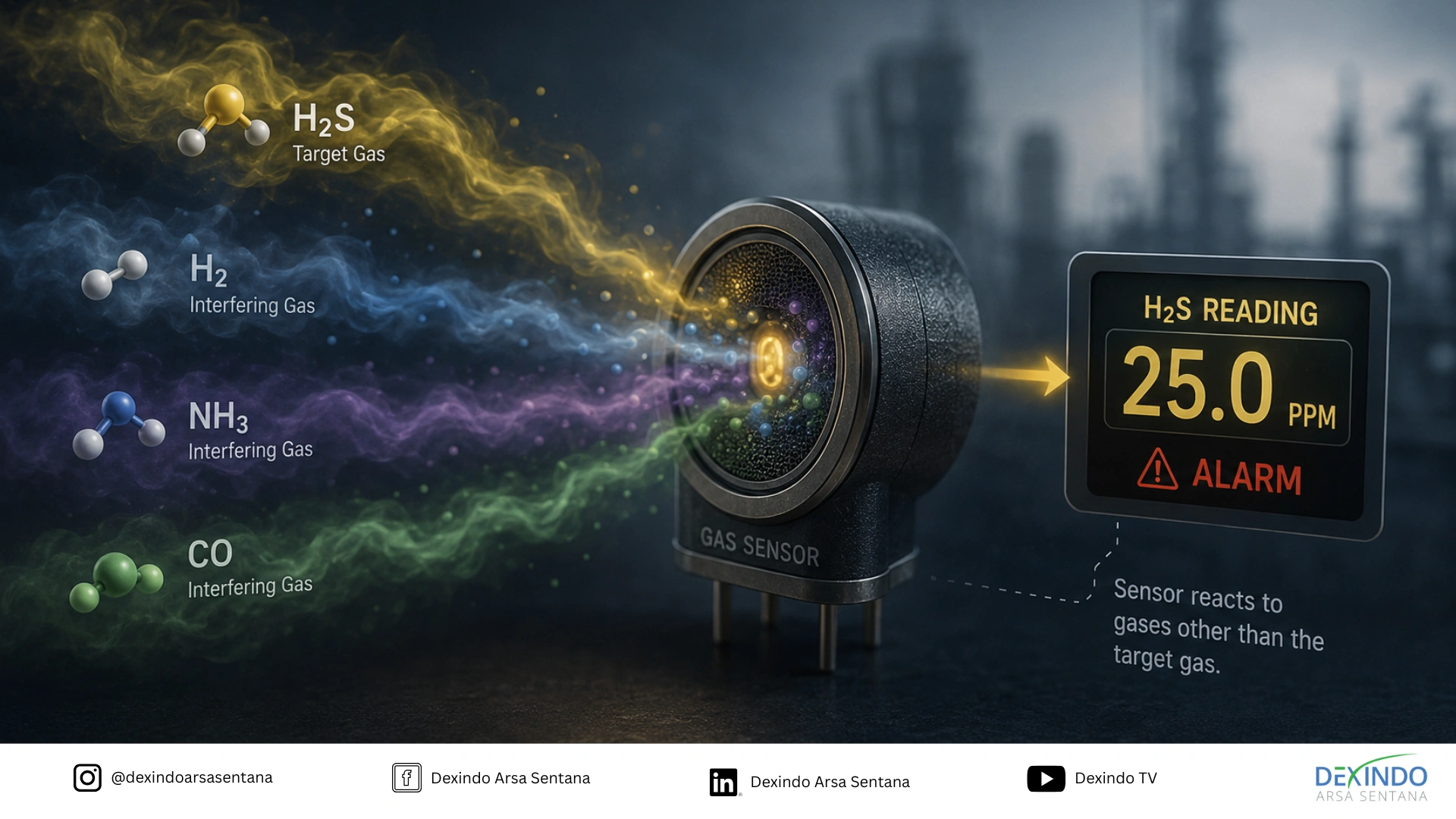
There is no such thing as a perfect gas sensor. Every sensor deployed in the field, whether it is protecting workers in a refinery, monitoring air quality in a hospital, or detecting refrigerant leaks in a data center, carries an inherent limitation: it can be triggered by gases it was never designed to detect.
What Is Cross Sensitivity?
Cross sensitivity (also written as cross-sensitivity, and sometimes called “cross interference” or “interfering gas response”) is defined as the tendency of a gas sensor to produce a measurable response when exposed to a gas other than its designated target gas. In other words, the sensor “mistakes” a foreign gas for the gas it is supposed to monitor even when the actual target gas is completely absent.
Cross sensitivity can produce:
- False positive readings
- False negative readings
- Suppressed sensor response
- Sensor inhibition or drift
Because gas detectors are widely used in safety-critical applications, even a small measurement error can create operational or safety risks.
Read: Know the Different: Single vs Multi Sensor Gas Detectors
Why Does Cross Sensitivity Occur?
Electrochemical Sensors
Cross sensitivity occurs because the electrode reacts not only with the target gas, but also with other gases that have similar electrochemical properties, producing additional current and false readings.
Metal Oxide Semiconductor (MOS) Sensors
Cross sensitivity occurs because the sensor responds to any gas that can react with oxygen on the heated oxide surface, making MOS sensors highly sensitive but less selective.
Illustration of Cross Sensitivity in Sensors
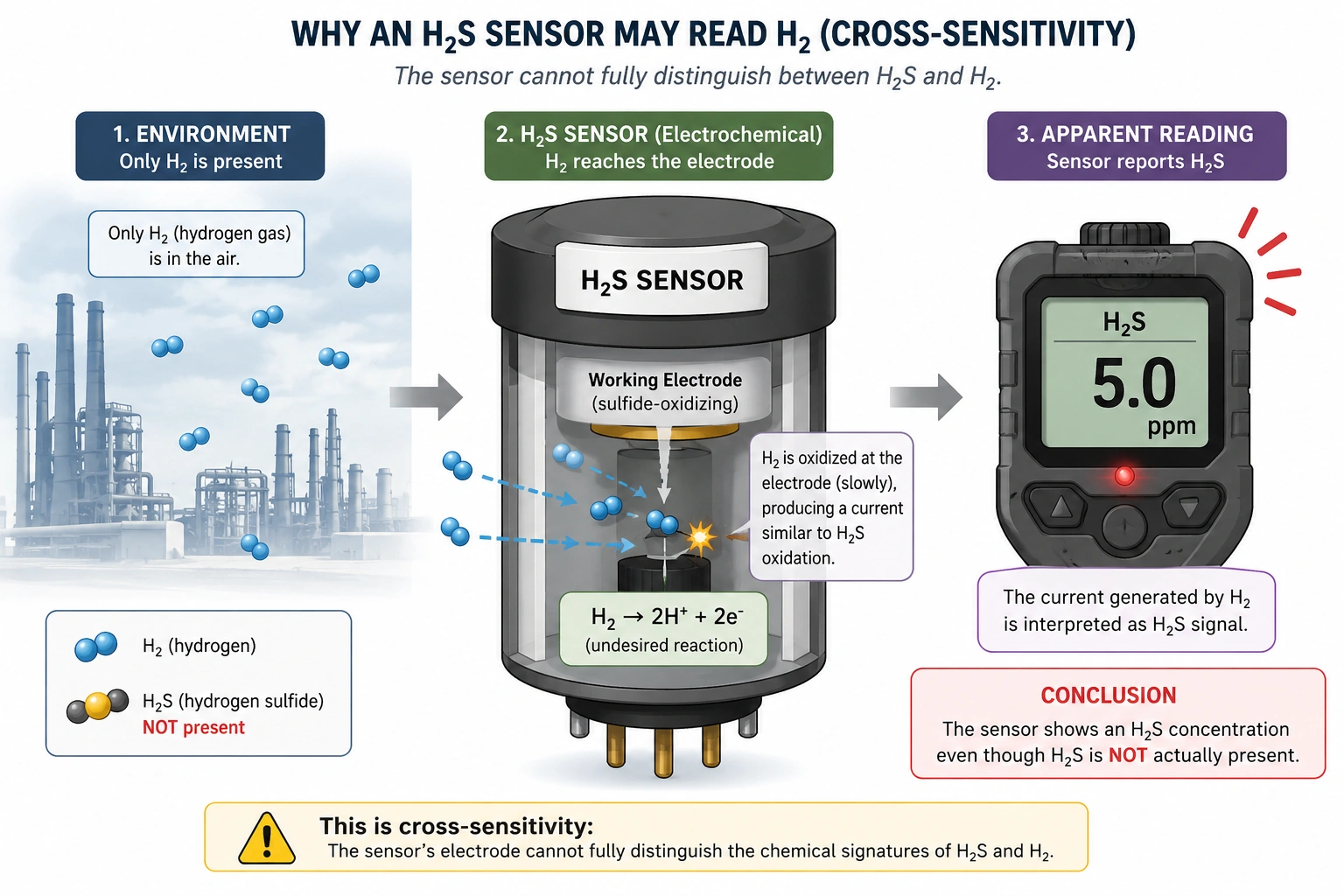
For example, an H₂S sensor may display a hydrogen sulfide concentration even when only hydrogen gas is present. The sensor is not intentionally malfunctioning; rather, the electrochemical processes inside the sensor cannot fully distinguish between the two gases.
The phenomenon is not a defect or a manufacturing flaw; it is a fundamental property of how gas sensors work at the chemical level. Almost all gases cause some degree of cross sensitivity in at least some sensor types. Understanding this is not optional for anyone who relies on gas detection for safety decisions.
Read: Understanding LEL (Lower Explosive Limit) in Gas Detector
What is Factors That Influence the Severity of Cross Sensitivity?
1. Electrode and Sensing Material Composition
The choice of electrode metal or metal oxide is the primary determinant of which interfering gases will cause cross response and to what degree. Platinum electrodes are broadly catalytic; gold electrodes tend to be more selective for certain toxic gas reactions. Manufacturers tailor electrode chemistry to balance sensitivity against selectivity.
2. Temperature and Humidity
Both the sensor’s operating temperature and the ambient temperature significantly affect reaction kinetics at the electrode surface. High humidity can cause competitive adsorption on the sensing surface and modify diffusion rates through the membrane.
MOS sensors operating at different temperatures exhibit different cross-sensitivity profiles a property that is exploited in temperature-modulated sensing arrays.
3. Sensor Age and Prior Exposure History
Fresh sensors and aged sensors often exhibit different cross-sensitivity responses. Extended exposure to high gas concentrations, contaminants, or repeated calibrations can alter the electrode surface chemistry, shift baseline readings, and change how the sensor responds to interfering gases.
Cross-sensitivity data published in datasheets applies to new sensors; real-world behavior may diverge significantly over the sensor’s service life.
4. Gas Concentration Ratios
The relative concentration of the target gas versus the interfering gas matters greatly. At very high interfering gas concentrations, even a sensor with low cross sensitivity may display significant false readings.
Conversely, extremely low interfering gas concentrations may be entirely within noise, producing no practical effect on the reading.
5. Diffusion Rate and Membrane Design
Many sensors incorporate a diffusion barrier membrane that controls the rate at which gas reaches the electrode. The membrane can also provide partial chemical selectivity.
Different gases have different molecular sizes and diffusion characteristics, which means membrane design can be tuned to preferentially admit the target gas though never perfectly.
6. Calibration Gas and Procedure
The type of calibration gas used, the order in which gases are applied during multi-gas bump tests, and the time allowed for sensor recovery between exposures all affect how the sensor’s baseline is set, which in turn influences how cross sensitivity manifests in field readings.
Read: How Gas Detector Sensors Work and Why Detection Can Fail
Consequences of Cross Sensitivity
Cross sensitivity is not merely an academic concern confined to sensor datasheets. It has tangible operational and safety consequences across virtually every industry that uses gas detection:
Warehousing and Battery Charging Facilities
Electric forklift battery chargers generate hydrogen gas during the charging cycle. In facilities with poorly designed ventilation, H₂ concentrations can reach several hundred ppm. CO sensors ubiquitous in warehouses that also use propane-powered forklifts cross-react strongly with H₂.
A measured 100 ppm of H₂ can result in a falsely displayed CO concentration of 40 ppm or more, well above alarm thresholds. This triggers evacuations and shutdowns with no actual CO hazard present, causing significant productivity losses and gradually desensitizing workers to alarms a phenomenon known as “alarm fatigue.”
Wastewater Treatment Plants
These environments simultaneously contain H₂S (produced by anaerobic decomposition), SO₂ (used as a dechlorinating agent), NH₃, and Cl₂. The cross-sensitivity interactions between these gases are particularly complex and dangerous.
An SO₂ sensor inhibited by NH₃ may fail to detect an SO₂ release; H₂S may inhibit Cl₂ sensors; and mutual negative responses between SO₂ and NO₂ sensors can create situations where both hazardous gases are present but neither is reported.
Food and Beverage Industry
Alcohol-based cleaning and sanitizing agents are used extensively, especially since the rise of enhanced hygiene protocols. CO sensors exposed to these sanitizers can show persistent false readings, as ethanol is a known cross-sensitive interfering gas for CO electrochemical sensors and recovery after exposure can be extremely slow, taking the sensor out of effective service for extended periods.
Oil and Gas Processing
Complex hydrocarbon mixtures at refineries and gas processing plants present numerous potential interfering gases. Mercaptans (thiol compounds used as odorants), hydrogen, and various light hydrocarbons all cross-react with different sensor technologies. Correct sensor selection and understanding of the specific chemical environment is critical for reliable monitoring.
Medical and Clean Room Environments
VOC sensors (often MOS-based) used for air quality monitoring in medical facilities can be triggered by disinfectants, pharmaceutical compounds, and even perfumes, complicating the interpretation of readings and potentially generating false alerts about hazardous conditions.
Read: Why Do Gas Detectors Trigger False Alarms? Causes and Solutions
How to Minimize Cross Sensitivity
While cross sensitivity cannot be completely eliminated in any current sensor technology, a combination of engineering, chemistry, and operational practices can reduce its impact dramatically.
1. Chemical Filters and Barrier Membranes
The most widely used practical mitigation is the incorporation of a chemical scrubber filter in front of the sensor’s diffusion barrier. These filters contain activated carbon, zeolites, or specific chemical adsorbents that preferentially absorb interfering gases before they reach the electrode, while allowing the target gas to pass through.
Important Limitation: At present, there is no filter technology that can eliminate all interfering gases simultaneously. Filters are effective mitigations, not perfect solutions, and their performance degrades over time with sensor aging and repeated exposure.
2. Electrode Optimization and Catalyst Pairing
Sensor manufacturers have developed specialized electrode designs to reduce cross sensitivity for the most problematic gas pairs. The CO/H₂ Low sensor, for example, uses a modified electrode with reduced platinum black catalyst loading on the counter electrode, making it less reactive to hydrogen. The CO/H₂ Null sensor goes further, using a four-electrode design that separately measures both CO and H₂ and mathematically subtracts the H₂ contribution from the displayed reading.
3. Multi-Electrode Combination Sensors
Sensors like the COSH (CO + H₂S combination) integrate dedicated electrodes for each target gas within a single sensor housing. Each electrode is optimized for one gas, and the instrument reads them independently allowing simultaneous monitoring of two gases without mutual interference. This approach sacrifices some compact form factor but provides much improved specificity.
4. Sensor Selection Based on Environment
Perhaps the most powerful mitigation of all is simply choosing the right sensor technology for the specific chemical environment. In environments where hydrogen is present, CO/H₂ compensated sensors should be specified. In complex multi-gas environments with known interfering gases, NDIR or laser-based sensors (for applicable gases) should be preferred over electrochemical alternatives where possible, given their inherently higher selectivity.
5. Strict Calibration Protocols
Following prescribed calibration procedures, including applying gases in the correct order, allowing sufficient recovery time between exposures, and performing calibrations in clean air environments — minimizes the chance that cross sensitivity responses are “baked in” to the sensor’s baseline during the calibration process.
Reference:
- https://pubs.acs.org/doi/10.1021/acssensors.4c02097